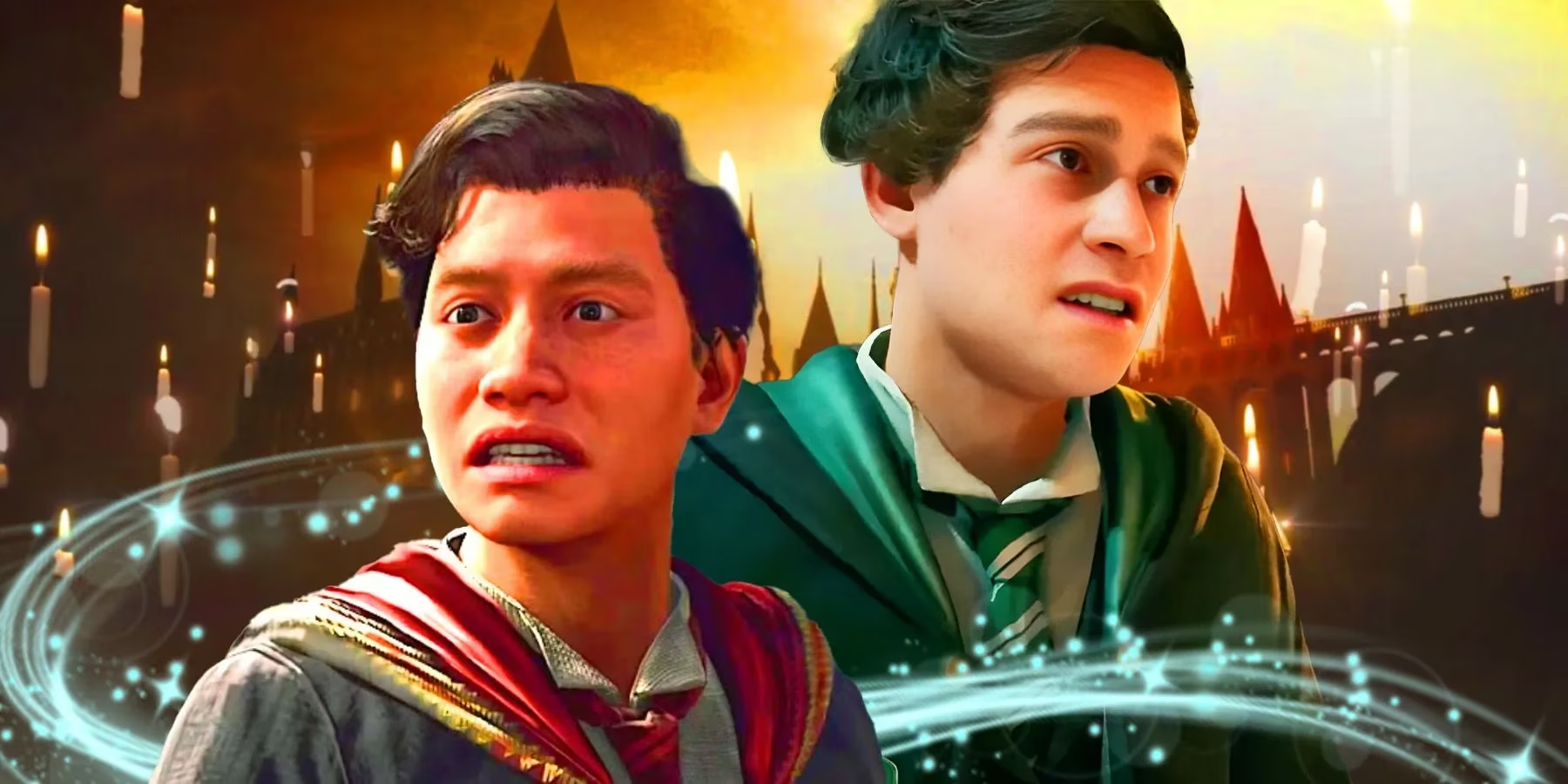
The magical dust from Hogwarts Legacy’s triumph in 2023 had barely settled before the whispers began. Warner Bros, like a wizard who just discovered Felix Felicis, saw an opportunity too golden to ignore. The game wasn't just a hit; it was a Portkey, transporting the entire Harry Potter franchise into a bold, interconnected new era. Forget isolated stories—by 2026, the wizarding world is knitting itself into a single, sprawling tapestry where every spell, every secret, is connected. The sequel is no longer just a follow-up game; oh no, it's become the lynchpin in a grand, corporate-designed symphony of magic, where your controller and your remote are destined to dance to the same, meticulously coordinated tune.
The Shared Universe Spell: A Corporate Imperative
Let’s be real, the last few Wizarding World films… well, let's just say they didn't exactly cast a cheering charm on audiences. So, when Hogwarts Legacy swooped in and made Galleons rain from the sky, Warner Bros executives didn't just see a successful game—they saw a blueprint. The strategy is clear as a freshly polished crystal ball: emulate the big leagues. Just like the Marvel Cinematic Universe and Star Wars, every new piece of Potter media—games, shows, movies—will now be intertwined through their stories. David Haddad, the president of Warner Bros. Interactive Entertainment, spilled the beans, confirming the games team is already in a deep huddle with the HBO series folks, coordinating big-picture storytelling elements for the Hogwarts Legacy sequel. What does that mean? Honestly, your guess is as good as mine. It’s all very hush-hush, a secret kept tighter than the entrance to the Chamber of Secrets.
The irony is thicker than a troll's skull. The first game’s genius was its distance—set a century before Harry’s birth, it had the freedom to play, to invent, to create new stories that weren't forced to connect. Now, the sequel might be shackled by a new mandate: Connect. Connect at all costs. This corporate synergy is a double-edged sword, sharp enough to either carve a masterpiece or accidentally sever the very charm that made the original so special.
Canon Conundrum: To Break or Not to Break?
Here’s the kicker: Hogwarts Legacy always played by the rules. It adhered to established canon like a first-year obeying Professor McGonagall. Any sequel would naturally follow suit. Warner Bros has the ghost of The Cursed Child hovering over them—a canon-breaking story that fans largely gave the cold shoulder. They're working overtime to avoid that reaction again, which is smart, but also raises the question: why force a connection if the original, disconnected formula was a roaring success? It feels like fixing a broomstick that isn't broken, just to say you used a fancy new spell.
Making the Connection Work: A Seeker's Challenge
So, how in Merlin’s name do you connect a game set in the 1890s with a TV show retelling the 1990s book saga? The worst-case scenario—and fans would riot—is if the sequel abandons its fabulous historical setting to inch closer to Harry’s time. That seems as likely as a peaceful interaction with a Hungarian Horntail.
The practical, and most probable, path is subtle world-building nods. Think of it like this:
-
The HBO show might drop a casual reference—a History of Magic professor droning on about the goblin rebellion of the 1890s, or a curious student in the library reading a dusty tome about ancient magic. It’s a wink, not a handshake.
-
The game sequel, however, will likely do the heavier lifting. It could conform to reference something in Harry Potter. Imagine a storyline where you, the player, uncover the dark, forbidden secrets of Horcruxes decades before Tom Riddle even thinks of them. Or perhaps you’re part of the journey to explore the origins of the Patronus Charm, that iconic defensive spell. Now that would be a legacy worth leaving.
One delicious possibility? If the sequel jumps forward a decade or two, we could cross paths with a young Albus Dumbledore during his Hogwarts years. Just a glimpse, a shared nod in the corridors—nothing that rewrites history, but everything that enriches it.
The Bottom Line: Magic or Muggle Management?
By 2026, the wizarding world is at a crossroads. The sequel to Hogwarts Legacy is caught in the middle—poised between being a groundbreaking game and a cog in a much larger franchise machine. The connection to the HBO series is inevitable; the corporate decree has been cast. The real magic will be in the execution. Will it feel like a natural expansion of a beloved world, or a clunky, forced piece of narrative engineering?
The hope, the fervent wish of every witch, wizard, and gaming Muggle, is that the storytellers remember what made the magic work in the first place: wonder, discovery, and a story that stands on its own two (broomstick-supported) feet. The spells of synergy are powerful, but they’re tricky. Let's hope they don't end up with a botched charm that makes the whole thing… disappear. Only time, and a hefty dose of Revelio, will tell.
| Hogwarts Legacy (2023) | The 2026 Vision |
|---|---|
| A standalone, historical adventure | A key node in an interconnected universe |
| Freedom to explore new lore | Potential narrative constraints for synergy |
| Subtle nods to main canon | Active coordination with HBO series storyline |
| Beloved for its independence | Tasked with being a franchise team player |
Comments