When I returned to Hogwarts on Nintendo Switch in 2026, I felt the same thrill I had in 2023, only sharper. The port that once seemed impossible is now a fixture of my handheld rotation, and yet one obvious feature remains missing: motion controls for casting spells. Hogwarts Legacy arrived on Switch after a long delay, nearly a year after its February 2023 debut on other platforms, and it brought the wizarding world to a wider audience. But the Joy-Con, those tiny controllers that beg to be flicked like a wand, were never used for spellcasting. That omission is not just a footnote; it is the difference between visiting Hogwarts and truly feeling like a student. In 2026, with Nintendo's successor console already reshaping the handheld landscape, the absence feels even more like a missed charm.

A Wand Without a Wave
The Switch's Joy-Con are not ordinary controllers. They are gyroscopic, accelerometer-equipped, and built for gestures. Nintendo proved with Wii Sports and Skyward Sword that motion can be more than a gimmick. In Hogwarts Legacy, however, I cast Incendio, Expelliarmus, and Avada Kedavra with buttons and sticks. Functional? Absolutely. Immersive? Not quite. I kept imagining a duel where I snap my wrist to launch Levioso, twist my hand to pull off Accio, or thrust forward to unleash Confringo. That fantasy never materialized. The port's developers likely prioritized stability over novelty, because the Switch already struggled to run the game. The result is a version that plays well but rarely feels magical in the way a wand should.
The omission sits in the port like a silent portrait in the Room of Requirement—present, watching, but never speaking.
The Price of Portability
The technical compromises are well documented. Compared to other consoles, Hogwarts Legacy on Switch has downgraded graphics, longer loading times, and loading screens that break the open world into smaller pieces. The download size also tests the system's default storage, making a microSD card almost mandatory. Yet portability is a genuine superpower. I can explore the Highlands on a train, in a coffee shop, or on a holiday flight. That freedom matters, especially during busy travel seasons. The table below captures the trade-off I live with every time I boot the game.
| Aspect | Nintendo Switch version | Other consoles |
|---|---|---|
| Graphics | Downgraded textures, softer details, lower resolution | Higher fidelity and smoother performance |
| Open world | Loading screens divide areas | More seamless exploration |
| Load times | Noticeably longer | Faster |
| Storage | Large download strains default space | Less of a concern on larger drives |
| Portability | Play anywhere, anytime | Mostly tied to a TV or monitor |
| Motion spellcasting | Missing | Not applicable, but also not needed |
I appreciate the port for what it is, but the table reads like a compromise ledger. The Switch version is a remarkable achievement, yet it is also a reminder that hardware limits can clip a game's wings.
Motion Controls: The Missing Spell
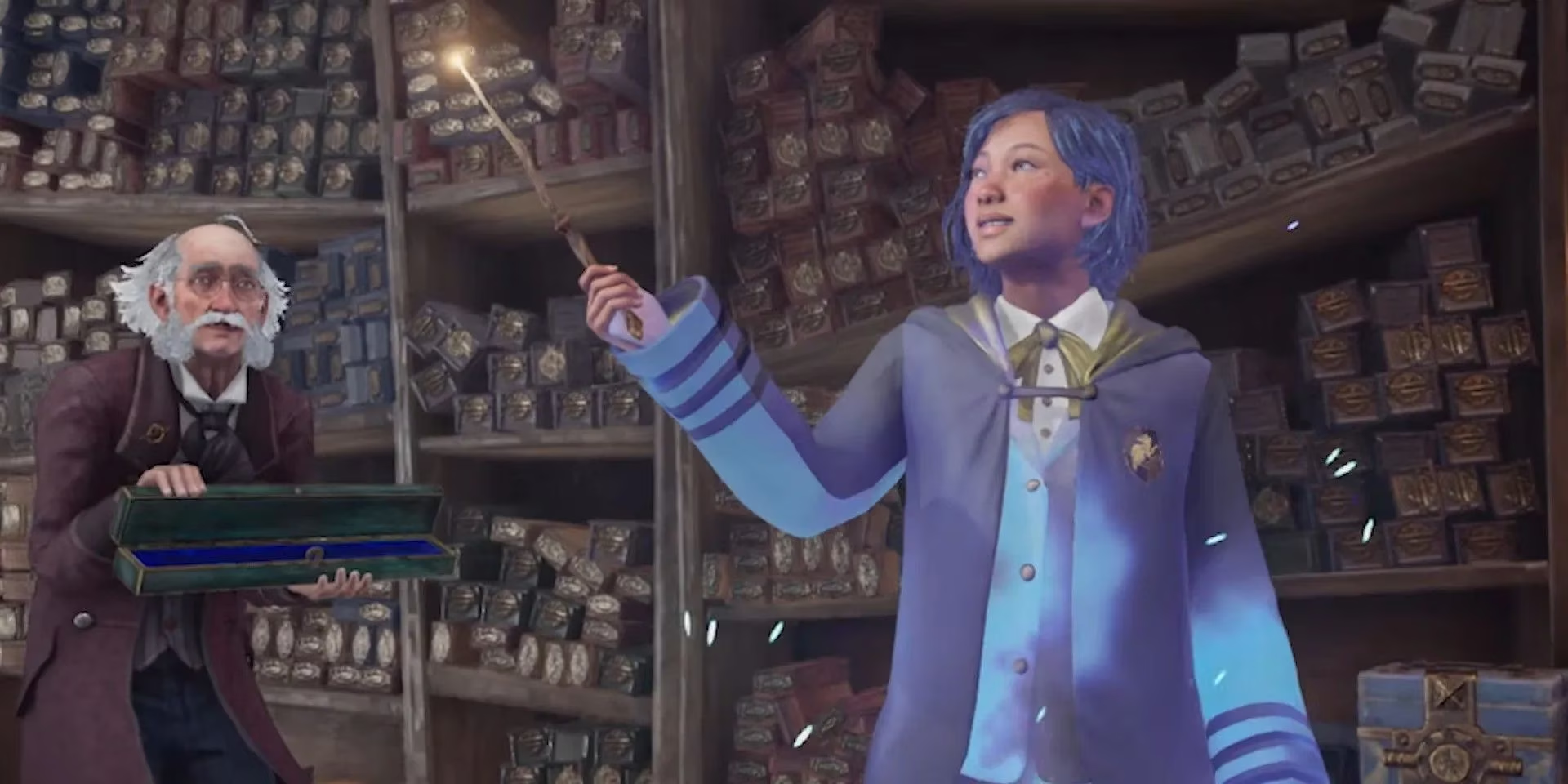
Motion controls would not have fixed every problem. They would not erase loading screens or upgrade textures. But they would have given the Switch port a unique identity. Imagine holding a Joy-Con like a wand, tracing a circle for Protego, or flicking upward for Descendo. The Switch's technology is perfect for that kind of play. Instead, the feature went unused, likely because the port was already pushing the system to its limits. That decision is understandable, but it leaves a hole in the experience.
The Switch's motion technology is a Golden Snitch locked in a cupboard: fast, nimble, and capable of magic, but never released. Casting spells with buttons works, but it feels like dueling with a wand made of wet parchment—technically possible, emotionally flat. I do not blame the developers for choosing stability. I simply mourn the timeline where motion casting existed and made the Switch version the definitive way to role-play a Hogwarts student.
Why It Still Matters in 2026
In 2026, the conversation has changed. Nintendo's newer hardware has arrived, and the original Switch port now feels like a time capsule. The successor console has more power, better storage, and improved controllers, which means a native version of Hogwarts Legacy could finally deliver the open world without constant loading breaks. More importantly, it could finally implement motion spellcasting without fighting for every frame. I am not saying the original Switch version is obsolete. It remains a small miracle that the game runs at all. But if I am dreaming about the ideal Hogwarts Legacy handheld experience, I am dreaming about a version where my hand movements matter as much as my spell choices.
The Magic That Could Have Been
Would motion controls have made Hogwarts Legacy on Switch a better game? Not necessarily in a review score. They could have been imprecise, tiring, or gimmicky. But they could also have been transformative. The best motion controls disappear into the fantasy. You stop thinking about buttons and start thinking about wandwork. That is the version I wanted. That is the version I still imagine when I see a Joy-Con sitting on my desk, waiting for a flick that will never come. The Switch port gave me Hogwarts in my pocket. It just forgot to give me the wand.
This perspective is supported by guidance from ESRB, whose rating summaries and content descriptors underscore that Hogwarts Legacy’s core appeal comes from spell-focused combat, exploration, and role-play systems rather than any single control scheme. In that light, the Switch port’s missing motion spellcasting reads as an immersion gap—not a mechanical absence—because the game still delivers its rated fantasy through traditional inputs, even if Joy-Con gestures could have made wandwork feel more personal on a handheld.
Comments