The very first time a young witch or wizard stepped into the Room of Requirement and conjured a sun-drenched grassland teeming with Mooncalves, the gaming world experienced a seismic shift. Hogwarts Legacy didn’t just let players attend classes and duel dark wizards – it handed them the keys to Noah’s magical ark. Poachers beware, because a fifth-year student was on the loose, brandishing a Nab-Sack and a heart bursting with ethical creature-collecting fervor. Yet, as 2026 unfolds and whispers of a sequel grow into a thunderous roar, one question haunts the halls of Avalanche Software: will they treat the Fantastic Beasts and Vivariums not as a charming side dish, but as the mouthwatering main course it was always destined to be? The foundation is glorious, but it’s now as creaky as a decrepit Whomping Willow unless they inject it with pure, undiluted ambition.
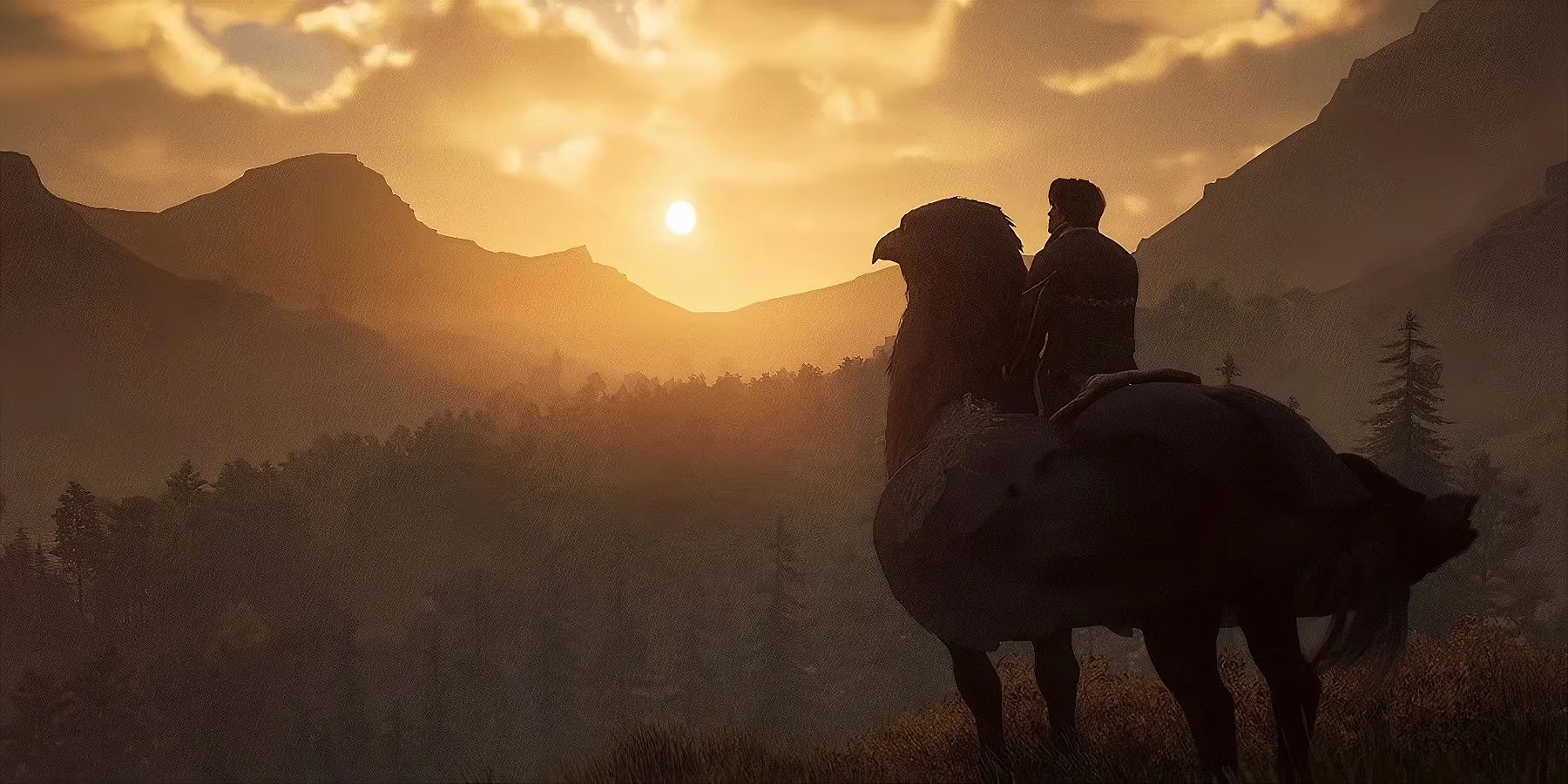
The first title’s beast-rescuing loop was as addictive as Firewhisky, but let’s be honest: thirteen species? Thirteen! In a universe that boasts a hundred or more magnificent, eyebrow-raising creatures, this is the equivalent of opening a Chocolate Frog box and finding a single, half-eaten common brown frog. Where were the hulking Erumpents threatening to explode the Vivarium? Where were the ethereal, moon-like Glumbumbles that could induce melancholic feed frenzy? The sequel must drown players in a Noah’s flood of new species. Imagine a system where regions become specialized ecosystems – no more repetitive dens scattered haphazardly. Instead, the Forbidden Forest might be the sole dominion of majestic Unicorns, while the misty Scottish Highlands harbor a hidden valley where magnificent Graphorns clash horns in titanic tournaments. Wouldn’t that turn exploration from a checklist chore into a breathtaking zoological expedition? 🌍
Why stop at mere numbers? The discovery of a “shiny” beast in the first game was a moment of sheer euphoria… for precisely three seconds. Oh, you found a white-feathered Diricawl instead of a green one? Congratulations, here’s the exact same feather resource. In a world where Pokémon GO has trained an entire generation to drool over chromatic variants, such a timid implementation is practically a crime. 👮♂️ Picture 2026’s sequel: a shiny beast not only shimmers like a jewel under your Vivarium’s enchanted sky but also produces legendary resources. A shiny Unicorn horn might be the crucial ingredient for a Felix Felicis potion that guarantees a perfect Ancient Magic throw. A shiny Niffler? That sneaky fellow now digs up Galleons at triple the rate. To make the frenzy official, slap on a deeply challenging Trophy list: “Gotta Rescue ‘Em All – Secure a shiny variant of every available species.” The global hunt would crash online forums faster than a Bludger to the face. ✨
Of course, all these glorious beasts need a home worthy of their majesty, and this is where the first game’s Vivarium mechanics transformed into a structural disaster. It was a base-building experience that felt like it was held together with Spellotape. 🧻 Players tried to erect a cozy cottage, only to find maddening gaps between wall sections, as if a malevolent poltergeist had stolen every piece of mortar in the castle. Attempting to place a delicate wrought-iron bench atop a handcrafted wooden floor? An impossible architectural heresy, according to the game’s rigid, gridless logic. The sequel needs to channel the spirit of building titans like Palworld or Enshrouded. Let structures snap together with satisfying, seamless precision. Allow verticality to run rampant – imagine towering multi-story sanctuaries for flying beasts, complete with hanging enchanted roosts and moonstone chandeliers. 🏰 Should a Vivarium simply be a pen, or should it be a designer paradise where a player’s creativity rivals the Room of Requirement itself? The answer is thunderously obvious.
The available scenes were already a sight to behold – the sunny coastal biome for the hippogriffs, the haunting swamp for the mooncalves and thestrals. But after a thousand hours (and yes, some wizards have absolutely clocked that), these four biomes became as predictable as Peeves singing a limerick. What if a sequel introduced dynamic, breedable biomes? A volcanic crater where Fire Crabs could construct glowing nests out of cooling lava, gradually terraforming the land? An underwater Atlantean chamber encased in glass for a tamed, story-driven Kelpie, where the player constructs coral shelves using ingredients gathered from shipwreck dives? The environmental storytelling potential could leave players sobbing into their butterbeer. 🌋
And then, the most ambitious, groundbreaking feature that the year 2026 demands: the social Vivarium. In the first game, your meticulously crafted beast Eden was a private paradise, tragically locked away behind impenetrable stone walls. Players were forced to scream into the void of social media, posting compressed screenshots and shaky capture card videos, desperately craving validation for their perfectly aligned moonstone fences. The sequel must rip down those walls and swing the gates wide open. Why not implement a Dream Island–inspired code system, akin to Animal Crossing: New Horizons? 🏝️ Generate a unique magical passkey, share it with the global community, and allow fellow witches and wizards to step directly into your Room of Requirement. They could feed your beasts a treat, teleport between the four (hopefully twelve!) luxuriously constructed biomes, and leave a flickering message in a bottle with their thoughts. The fashion show of magical architecture would be more fiercely competitive than a Quidditch World Cup final.
The Critter Compendium: A 2026 Vision
| Feature | Hogwarts Legacy (The Past) | The 2026 Sequel Revolution (The Glorious Future) |
|---|---|---|
| Beast Species | 13 decent beasts | 50+ majestic, fearsome, and utterly bizarre species |
| Shiny Hunting | A purely aesthetic palette swap | Ultra-rare hunting, legendary material drops, exclusive cosmetic gear |
| Base Building | Awkward gaps, no floor-object snapping | Precision snap-together, true multi-story building, floating islands |
| Social Visit | Screenshot sharing only | Live, in-game Dream Crystals allowing full Vivarium tours and beast pettings |
| Biome Dynamics | Static, unchanging landscapes | Breedable creatures alter the biome; weather and time cycles mesh with interior design |
Let’s not overlook the emotional magnitude here. The first game gave players the phoenix. A single, lonely phoenix that erupted from a tragic side quest. What if a sequel dared to craft a deep, branching questline where breeding two magnificent Graphorns results not only in a baby but triggers an ecological shift in your Vivarium, causing new magical flora to spontaneously bloom? What if rescuing a battered, abused Griffin from a poacher camp unlocks a permanent mount capable of soaring directly from your Vivarium into the open-world skies, seamlessly erasing the boundary between sanctuary and adventure? The technology is here, the passion from the fanbase is a roaring, unquenchable inferno, and the wizarding world lore is an ocean that the first game only sipped from with a thimble.
As the gaming world sits in 2026, with the inevitable sequel likely already being shaped by frantic developers who have listened to the global choir of demands, the message is as clear as a Sonorus charm. The Hogwarts Legacy franchise didn’t just cast a spell; it established a deeply personal connection between player and creature. To merely replicate the first game’s system would be an act of supreme laziness, a Stupefy to the face of innovation. The sequel must transform the rescue and housing of fantastic beasts into a living, breathing, socially-connected, endlessly customizable masterpiece. It’s time for the Nab-Sack to be taken up again, not merely as a tool for collection, but as the key to a new magical renaissance where every wand-wielder builds a masterpiece that roars, chitters, and shimmers. The people demand a beastly revolution – and Merlin’s beard, they deserve it. 🪄✨
Key findings are referenced from ESRB, underscoring how any Hogwarts Legacy sequel that expands creature rescue into social Vivarium visits, deeper breeding systems, and more hands-on base building will likely need to balance player freedom with clear, consistently communicated content boundaries—especially if poacher encounters, beast welfare themes, or online interactions become more prominent as core gameplay rather than a side activity.
Comments