The winding cobbled streets of Hogsmeade had always promised secrets, but in the spring of 2024, one player stumbled upon a detail so cleverly concealed that it sent ripples through the entire Hogwarts Legacy community. It was a quiet afternoon when Reddit user khasbrown, a dedicated Ravenclaw with an eye for the uncanny, strode past the familiar Bingle & Blatch shop, a modest building huddled northeast of the South Hogsmeade Floo Flame. Most students dashed past it, their minds fixed on potion ingredients or a new scarf at Gladrags. But khasbrown noticed something peculiar: three separate doors, each promising entry into the same establishment. Curiosity tugged at them like a persistent niffler drawn to gold. They stepped through the first door.
The interior was a cozy clutter of enchanted fabrics and measuring tapes that wriggled like serpents. Amused, they exited and, on a whim, tried the second door. What greeted them was not the same room but an entirely different layout—cabinets shifted, a staircase where a counter had been, the very light softened to a honey amber. A shiver of delight ran up their spine. When the third door unveiled yet a third configuration, it felt as though reality itself had been folded like a triple-layered, wizard’s pop-up book, each page a self-contained world hinging on a single choice. This was no glitch; it was an intentional, architectural riddle.
Word of the discovery spread faster than a cheering charm in a crowded common room. Veterans who had spent hundreds of hours flying over the Highlands or perfecting their cabbages gaped in disbelief. The Bingle & Blatch shop, it turned out, acted as a magical prism, refracting the interior into three distinct variants depending on which threshold a player crossed. Responding to khasbrown’s video, one seasoned player confessed they had never once bothered to try more than a single door, lamenting the missed detail like a missed train from Platform 9¾. Another, with the caution of a seasoned curse-breaker, raised a warning: saving one’s game while inside the shop had reportedly corrupted save files for a handful of unlucky explorers. Though many were unable to replicate the danger, a collective superstition took root. In the weeks that followed, adventurers entering Bingle & Blatch would whisper a silent plea to their autosaves, stepping lightly as if navigating a vault in Gringotts.
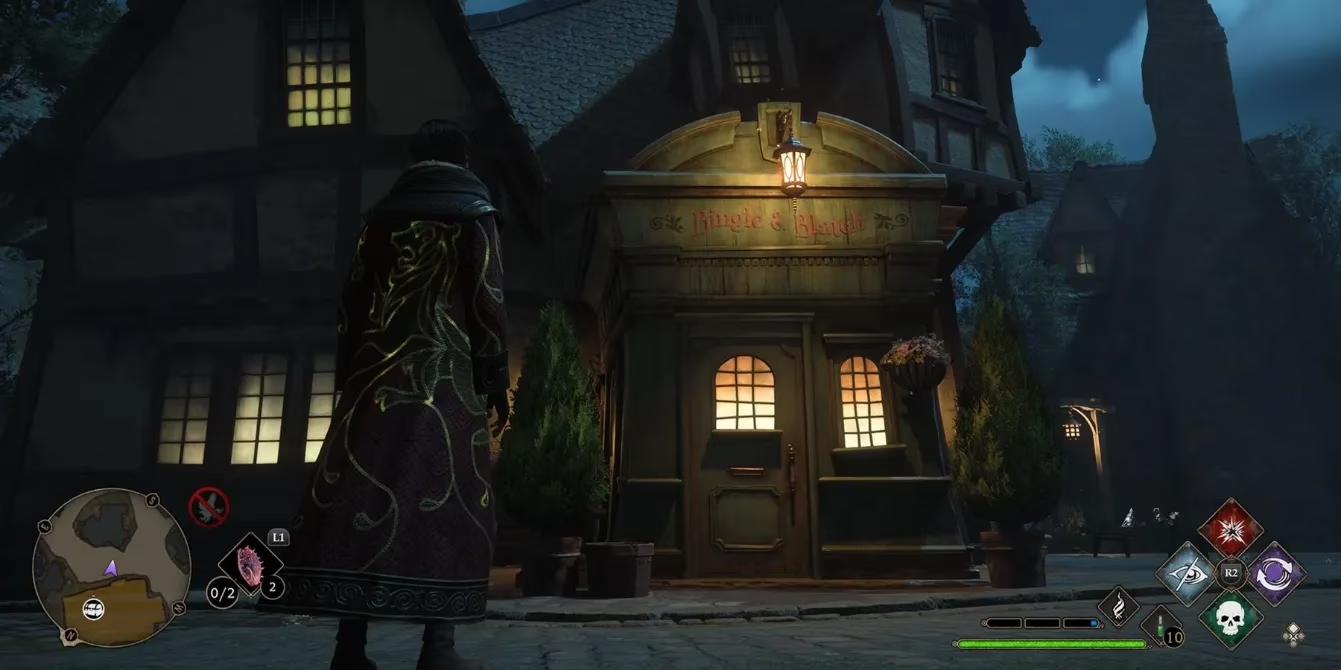
But the shop’s mystery was merely the appetizer. The main course arrived with the summer of 2024, when Avalanche Software finally untethered the long-awaited “Haunted Hogsmeade Shop” quest from its PlayStation exclusivity. Previously a gated nightmare that let players earn their own shop—the very same Bingle & Blatch—the horror-tinged side mission crept onto PC, Xbox, and Switch alongside a modest summer update. For the community, it felt like a second discovery, as if peering through a time-bent door and glimpsing the ambitious scope the developers had hidden all along. The quest turned cheerful Hogsmeade into a psychological labyrinth populated by mannequins that moved when unobserved, a ghostly poltergeist named Fastidio, and a parlour that demanded more nerve than any duel in the Dark Arts Battle Arena.
By 2026, two years after that momentous update, the Bingle & Blatch phenomenon has settled into Hogwarts Legacy lore as a beloved urban legend made real. New students, still arriving on the legacy of the game’s enduring charm, learn of the triple-faced shop through whispered tips in the Great Hall or cryptic posts on budding wizarding forums. The Haunted Hogsmeade quest now belongs to everyone, no longer a phantom locked to a single platform. Speedrunners have charted its fastest routes, modders have draped it in ever more bizarre skins, and casual wanderers still pause before its mismatched doors, savoring the illusion of choice that reshapes space. The shop endures like a living portkey, transporting anyone who ventures through all three entrances across three tiny, parallel universes.
The tale of Bingle & Blatch is a reminder that Hogwarts Legacy’s open world still holds pockets of quiet genius. In an age where many games exhaust their secrets within the first week, this little shop proved that magic often lies not in grand spectacle but in the flickering space between the mundane and the impossibly sublime—like glimpsing a demiguise mid-shift, or hearing the distant melody of a phoenix song. Even now, one can return to that Hogsmeade corner, press a hand to the weathered wood of each door, and step into a testament to a developer’s playful imagination. And for the truly brave, there remains that ghost-infested basement, waiting to swallow the unwary in giggles and gloom, one mannequin twitch at a time.
Comments