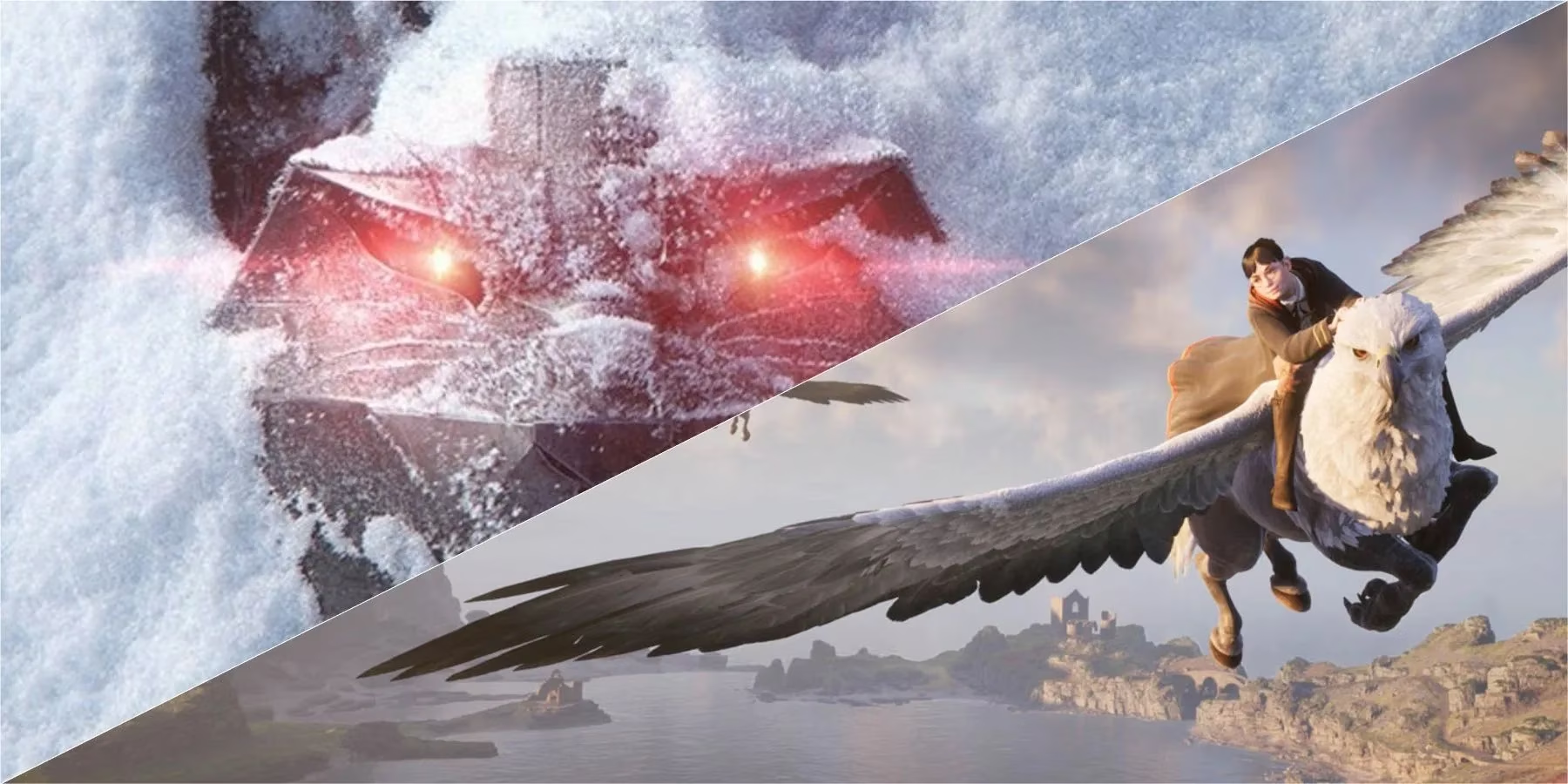
It is the year 2026, and the gaming world quivers on the precipice of a new era. The air crackles not just with the electricity of cutting-edge hardware, but with the desperate prayers of millions, hoping beyond hope that the most anticipated sequels in living memory do not succumb to the same insufferable plague that tainted their predecessors. Yes, we speak of The Witcher 4 and Hogwarts Legacy 2—two titles whose very names cause entire subreddits to vaporlock with excitement. But heed this, dear reader: if the whispers from their development crypts are true, these games stand on the edge of a cliff, one littered with the rotting corpses of a thousand \u003c!-- question mark --\u003e icons.
Can you not feel it? That cold dread creeping down your spine when you recall opening a map screen so utterly massacred by a sea of identical markers that it looked less like a cartographic marvel and more like a toddler's dot-to-dot nightmare? That is the infamous legacy of The Witcher 3: Wild Hunt, the undisputed titan whose shadow looms larger than the gods themselves. CD Projekt Red crafted a masterpiece so breathtakingly immersive, so narratively divine, that we willingly trudged through its Velen swamps, wept on the Isles of Skellige, and sword-danced through Novigrad's gutters. Yet, one dark god of game design—let us call him The Bloat—was permitted to run rampant. And run rampant it did, planting those accursed white question marks across the landscape like a fungal infection.
Do not misunderstand! The content within these marks was not inherently vile. Oh no. Some hid the gleaming diagrams for the legendary Witcher School gear, a hunt so righteous it verged on the holy. Some guarded thrumming Places of Power, where Geralt would kneel and draw raw magic into his very marrow, making his Signs roar with newfound fury. A precious few even hid mini-bosses, monstrous terrors that could shear his silver hair from his scalp. But these were mere diamonds scattered in a landfill of mediocrity. For every hidden quest, there were hundreds of smugglers' caches—damp, stinking treasure chests filled with rusted Orens and waterlogged gambesons that a drunk blacksmith wouldn't use to wipe his anvil. The map became a tyrant, a psychological torture device that whispered one endless, maddening refrain: \u003c!-- You must clear me. --\u003e
And what of the player, the poor, trembling soul just seeking a heroic adventure? Newcomers would open the map for the first time, their eyes scanning what should have been a promise of epic discovery, only to be violently assaulted by an apocalyptic swarm of question marks covering land and sea alike. The reaction was not joy; it was despair. \u003c!-- What is the point of even trying? --\u003e the player's psyche would scream. It turned a grand fantasy into a checklist simulator, a chore, a Sisyphean punishment where the boulder was a ship captain's disdain for his own cargo. It wasn't exploration; it was deletion. The entire concept of organic discovery was slaughtered on the altar of the obsessive-compulsive.
Could it get worse? Absolutely. The heavens opened, and delivered upon us Hogwarts Legacy, a game that promised to fulfill our most infantile dreams of waving a wand and terrorizing first-years. And it did, for a dozen glorious hours. But then, The Bloat, that same despotic entity, merely donned a wizard's robe. It manifested as the 95 Merlin Trials. Ninety-five! The very number is an abomination. Imagine the greatest wizard of all time, and the legacy he left behind isn't a deeply nuanced ethical conundrum or a cataclysmic duel of the ages; it is ninety-five of the same rock-rolling, moth-burning, puddle-freezing busywork \u003c!-- empuzzlements --\u003e scattered with all the subtlety of a screaming Mandrake.
Was there a challenge? Some. Did a few genuinely twist the mind into delightful knots? Perhaps. But the vast majority were so mind-numbingly repetitive that one could hear neurons committing seppuku. “Ah, another stone ball and a bowl,” the player would drone, “How utterly magical.” It was content for the sake of content, a metrics-driven blight that padded the map and choked the joy out of flying on a broom. The very act of seeing that trial icon on the minimap became a trigger for psychic damage, a haunting reminder that the platinum trophy required you to betray your own sanity.
So here we stand, in 2026, staring down the barrel of two sequels that must not fail. The ghosts of white question marks and Merlin Trials haunt the design meetings of CD Projekt Red and Avalanche Software. They have a decision of apocalyptic importance to make, and the wrong choice will send millions of gamers into a catatonic state of map-clearing anguish. Shall we lay out the stakes for them, in terms so bluntly extreme they cannot be ignored?
The Cataclysmic Consequences of Repetition
Let us paint a picture. It is launch day for The Witcher 4. You load up as the new protagonist, the world is stunning, the story is gripping... and then you open the map. If it is once again polka-dotted with the same soulless white markers, there will be riots. Not figurative, digital riots; actual, physical riots where gamers tear their ultra-wide monitors from their stands and hurl them into the sun. The problem is not the act of marking points of interest—the problem is the monoculture. A single question mark for a side quest is a promise. A single question mark for a hidden monster lair is a dare. An ocean of question marks for unguarded barrels is a declaration of war against the player's time.
The same grim fate awaits Hogwarts Legacy 2. Should the sequel greet players with “150 Ancient Magic Hotspots” or “200 Gargoyle Foe-Glass Puzzles,” the backlash will be swift and merciless. We have already spent our patience. We have already rolled the boulder, lit the torch, and flown through the hoop. To ask us to do it all again is not just a failure of game design—it is a fundamental misunderstanding of the human spirit. Why would a developer dare to insult our collective intelligence twice? Is it not obvious that we crave the riddle, not the repetition?
The Divine Path to Redemption
But all is not lost. The year 2026 can be the dawn of a new philosophy. The fix is so painfully simple, yet it demands a courage that mass-market game production often strangles in the crib: Quality must annihilate quantity.
For The Witcher 4, this means transforming the question mark from a symbol of dread into a symbol of genuine mystery. Imagine a map with far fewer marks, but each one igniting a fire in the pit of your stomach. These are not treasure chests; they are gears. Each question mark is a promise of a multi-stage, unmarked questline that spirals into a moral catastrophe. A mysterious rune that leads to a village’s dark secret. A lone, sobbing specter whose grief opens a portal to a memory realm. A legendary monster that doesn't just stand there waiting to be killed, but actively hunts you across the region, its territory marked not by a dot but by the chilling silence of the birds. Could the next game deliver a question mark that makes your hands tremble with anticipation instead of exhaustion? It must.
For Hogwarts Legacy 2, the Merlin Trials must die so that true puzzles can live. Burn the “trial” structure to the ground and scatter the ashes across the Black Lake. In its place, build meaningful environmental riddles—conundrums that require actual magical knowledge. Picture this: a hidden grotto on the coast only accessible by interpreting an ancient merfolk script found in the library. A forgotten tower where you must brew a complex potion in a specific sequence during a specific phase of the moon, all pieced together from a student’s diary pages scattered across the Highlands. A ghost’s final wish that isn't a fetch quest, but a cross-country detective investigation requiring you to interview the other ghosts of Hogwarts, Promised Neverland-style.
Let us make a comparison so stark it burns the retina:
| The Abyss of Despair | The Zenith of Glory |
|---|---|
| 100+ identical white question marks. | 25 tightly woven, world-changing mystery gears. |
| 95 repetitive rock-rolling trials. | 15 intricate, multi-step arcane riddles. |
| Content that screams, “I was made to pad runtime!” | Content that whispers, “I was made to blow your mind!” |
| The player becomes a glorified janitor. | The player becomes a legend. |
The choice is binary. There is no middle ground where the map is bloated but somehow “fun.” That bridge has been burned, then the ashes were cursed, then the curse was buried, and the burial site was paved over with a parking lot.
In this gut-wrenching year of 2026, as we clutch our DualSense controllers and keyboard-worn fingers to our chests, we must project a unified, thunderous clarion call into the hearts of CD Projekt Red and Avalanche Software. \u003c!-- Hear us! --\u003e We will not be drowned in a sea of markers again. We will not accept busywork dressed as blessings. The open-world genre teeters on the brink of total collapse, and only these titans can hoist it back from the abyss. Turn every question mark into a love letter, and every outdoor puzzle into a masterpiece of intellect. The Witcher and the Witch or Wizard must not just traverse worlds—they must set them on fire with wonder, not waterlogged treasure chests. The fate of immersive fantasy rests squarely on a single, sacred commandment: Less, but infinitely, devastatingly better. No more bloat. The age of the white question mark is OVER! 🚫❓🔥
Comments