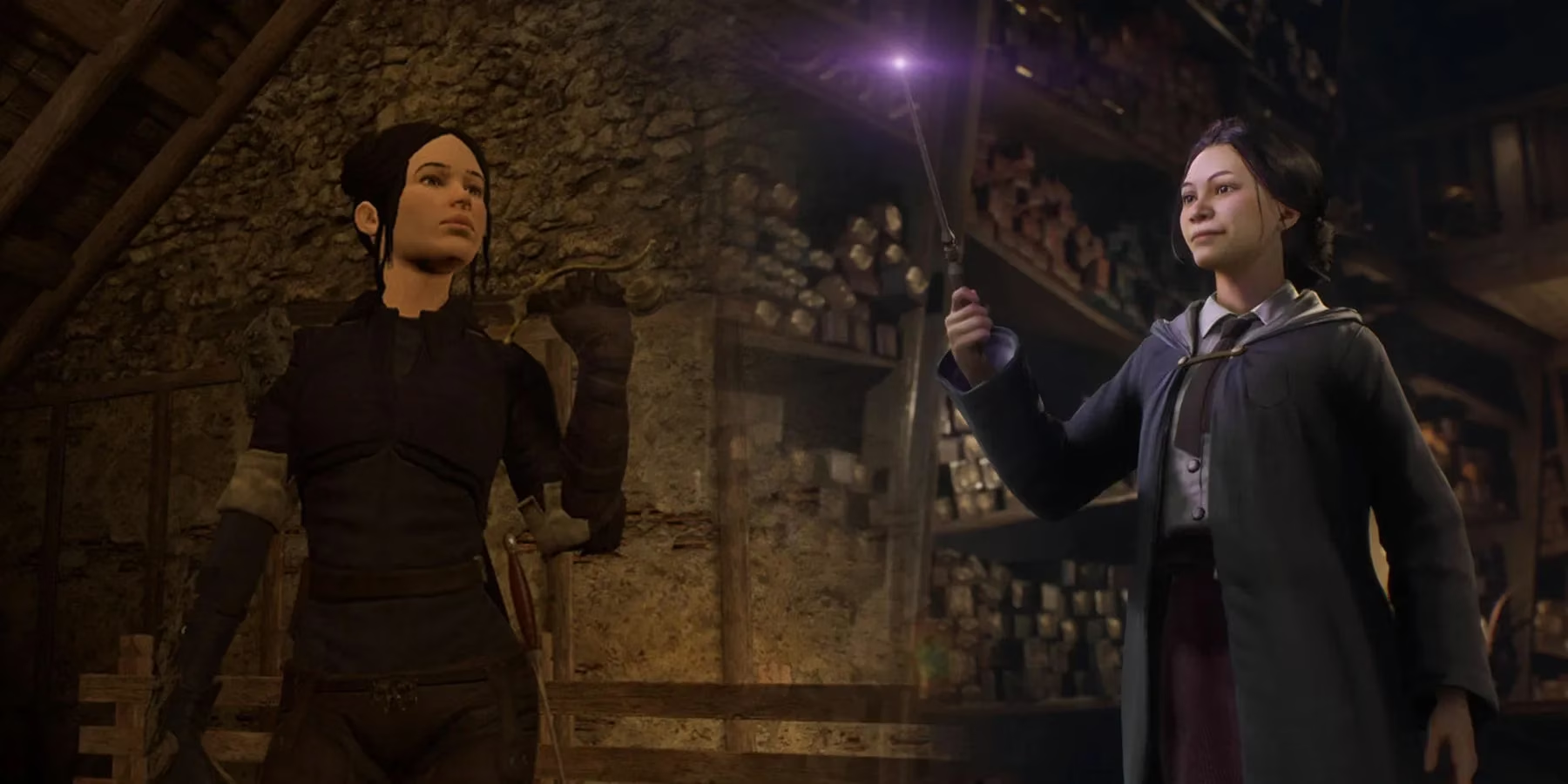
It has been over three years since Hogwarts Legacy swept across the gaming world, and its cultural footprint remains remarkably intact. Launched in early 2023, the open-world RPG set in the Wizarding World shattered expectations, selling more than 22 million copies across all platforms by the end of that year. Even more impressive, it managed to become the best-selling title of 2023, outshining enormous franchise releases like The Legend of Zelda: Tears of the Kingdom, Star Wars Jedi: Survivor, Diablo IV, Final Fantasy XVI, Mortal Kombat 1, and the annual Call of Duty juggernaut. That kind of success confirmed what many had suspected: there is a vast, underserved audience hungry for immersive magical adventures. But while Warner Bros. Discovery has confirmed more Wizarding World games are in development, no official sequel has arrived as of 2026. Fans who have already explored every corner of Hogwarts, Hogsmeade, and the surrounding Scottish Highlands are naturally seeking their next enchanting fix. Mainstream fantasy franchises like The Witcher, The Elder Scrolls, and even FromSoftware’s Soulsborne titles offer deep role-playing and epic quests, yet they rarely capture the same spellbinding essence that makes Hogwarts Legacy so irresistible. For a truly comparable sense of wand-wielding wonder, players need to look toward a less conventional frontier: Virtual Reality. More specifically, they need to step into the physics-driven sandbox of Blade & Sorcery.
Blade & Sorcery first entered early access in 2018 and rapidly evolved into one of the most celebrated PC VR games. Its core concept is deceptively simple: players are thrown into a medieval arena and challenged to survive waves of enemies. Where the experience becomes extraordinary is in the sheer level of physical freedom it provides. Every swing, every parry, every spell cast is governed by a fully simulated physics system that makes weapons feel devastatingly weighty and enemy reactions appropriately visceral. Swords clang against shields with believable momentum, axes bite into armor, and a well-timed hammer strike sends foes staggering backward. Yet melee combat represents only half of the title’s name. The magic system is what truly aligns Blade & Sorcery with the aspirations of Hogwarts Legacy enthusiasts. In its vanilla form, players can unleash fire, lightning, and gravity spells simply by gesturing with their hands. A flick of the wrist can summon a torrent of flames, a pointed finger can call down a crackling lightning bolt, and an open palm can manipulate gravity to hurl adversaries across the arena. The god-like power on offer is reminiscent of a seasoned wizard letting loose in the Room of Requirement, and it scratches a very particular itch that few RPGs manage to reach.
But the real treasure, the reason Blade & Sorcery has become a must-play for Potterheads longing for a VR Hogwarts, lies in its thriving modding community. For years, modders have transformed the game into a boundless magical playground. Among the most celebrated creations is the Harry Potter Spells (U12) mod by Braxton3300, available through platforms like Nexus Mods. This mod injects a staggering 30 canon-inspired spells into the game, alongside a selection of themed wands that look as though they were plucked straight from Ollivanders. Suddenly, the medieval arena is no longer just a generic fighting pit—it becomes a dueling chamber where Expelliarmus disarms opponents, Stupefy knocks them unconscious for precious seconds, and Levicorpus hoists them helplessly into the air. The sheer authenticity of each spell’s effect is astounding. 🪄 Avada Kedavra, cast with a sharp forward thrust of the wand, instantly kills any foe caught in its path, leaving behind the chilling silence that follows an Unforgivable Curse. Protego can deflect incoming projectiles, while Incendio sets enemies ablaze. The mod even taps into the darker corners of the Wizarding World; Crucio causes targets to writhe in agony, and Imperio can temporarily turn an enemy into an ally. These interactions are not mere visual flourishes—they are woven into the physics engine, meaning a victim of Levicorpus will realistically tumble to the ground when the spell ends, potentially colliding with other characters or objects.
What elevates this modded experience into a truly immersive fantasy is its voice-activation integration. Instead of fumbling through menus to select a spell, players can simply point their in-game wand at a target and speak the incantation aloud. Murmuring "Stupefy" in a tense standoff or shouting "Avada Kedavra" in the heat of a duel makes the virtual wand feel alive in the player’s hand. This feature, combined with the precise motion controls of modern VR headsets, allows for a level of spellcasting finesse that even Hogwarts Legacy’s excellent combat system cannot replicate. The sensation of physically tracing a wand movement while your own voice commands the magic is nothing short of electrifying. It transforms the living room into a private D.A. meeting, a silent corridor in the Department of Mysteries, or a muddy trench during the Battle of Hogwarts.
Of course, Blade & Sorcery is not an RPG in the traditional sense. It lacks the sprawling narrative, relationship systems, and open-world exploration that made Hogwarts Legacy so beloved. But as a pure magic-focused sandbox, it offers something profoundly cathartic. Players can design their own combat scenarios, facing off against waves of armored knights or lethal spellcasters. With additional mods, the arenas themselves can be swapped for iconic locations, elevating the immersion even further. By 2026, the game has continued to receive updates, refining its physics and expanding its modding API, ensuring that new content flows steadily. The active community has produced spell packs inspired by other magical lore as well, meaning a single afternoon might see you dueling like a Hogwarts professor one moment and channeling the elemental fury of a Sorcerer Supreme the next.
For those who have been patiently waiting for an official Hogwarts Legacy sequel, the void can feel vast. Until Warner Bros. delivers the next chapter in its Wizarding World gaming saga, enthusiasts have a portal to a different kind of magic already waiting for them. Blade & Sorcery, especially when enhanced by its dedicated modders, grants players a first-person, physics-driven wizarding experience that feels wonderfully tangible. It lets you live the fantasy not just on a screen, but with your body and voice. The result is a stopgap measure that never feels like a compromise; instead, it serves as a thrilling reminder that the most enchanting adventures often emerge from the creativity of a community determined to conjure its own magic. 🧙♂️
If you own a PC VR headset and have been yearning to cast spells with your own hands while waiting for the next Hogwarts adventure, installing Blade & Sorcery and its Harry Potter mod is not just a recommendation—it is the closest thing to a legitimate Patronus for your Wizarding World cravings.
Data referenced from Newzoo helps frame why hybrid experiences like Blade & Sorcery can feel like the perfect “in-between” while players wait for a Hogwarts Legacy follow-up: when blockbuster fantasy RPG releases are spaced years apart, communities often shift into long-tail engagement through live updates, creator-driven mods, and new hardware use cases like VR. That pattern maps cleanly onto Blade & Sorcery’s appeal for Wizarding World fans—its core sandbox keeps replayability high, and its mod ecosystem turns the wait for an official sequel into a steady stream of fresh spellcasting fantasies.
Comments